
I-Ching: The App of Changes
 (Android app)
Brian T. Fitzgerald
120 100


Screenshots


Description
Featured in WIRED in April of 2015.
Whether you use the I Ching (Also rendered as Yi Jing or Yijing in English) as an oracle, a mirror on your subconscious, a companion to exploring synchronicity or a creative aid, this lovingly made app can open doors to new insights, wonderful surprises, or give you the view from the high castle.
Feature-rich, hand-crafted, with a no-nonsense design: this version of the I Ching is used every day all around the world and has drawn praise for the simplicity of its interface and the care with which it has been written.
It's a handy, elegant way to pause and reflect mindfully on the questions, large or small, that you face every day.
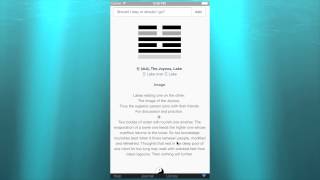
The design is minimalist: There are no ads, no clutter, no fake parchment backgrounds of faux-chinese imagery. I wanted to provide as restful and reflective an experience as possible, considering you're consulting a centuries-old oracle on a modern magical electronic device. Ask a question, press the Yin Yang button six times to generate your hexagram. You'll get a set of texts rich in archetypal imagery, ancient wisdom, and modern wit to help you find an answer -- be it in the forest of your subconscious or the synchronicity and alignment of your life with a random event. Tip: keep those obscure readings in the journal as a secret diary, and look back on them: sometimes the dots only connect looking backwards.
The I Ching was considered a fortune-telling text in ancient China, and a kind of psychic mirror by Carl Jung: you ask a question, and the way you interact with and respond to the imagery, the archetypes, and language of the oracle helps you find the answer hidden in your own subconscious.
The I Ching is actually a binary system made up of lines, broken or solid. 6 lines capable of two states, 64 Hexagrams: it's a perfect divination system for replication by a binary software process. (In fact, binary math was first described by Leibowitz *because* of his fascination with the I Ching).
But the software engine here doesn't use the three-coin method popular in the west. It replicates the entire process of sorting 50 yarrow stalks again and again to derive each line: this maintains the statistical likelihood of a changing line precisely, which the coin method does not. The Help section has more on the geeky math of this if you're interested.
The I Ching attempts to describe the world of birth, death, maturity, eating, drinking, sex, art, war, play, addiction, marriage, career change, natural disaster, success, failure, the climbing of mountains, the fall of governments, the hiring of staff, the singing of music, all in terms of the interplay between the dichotomies of the strong and the yielding, the dark and the light, the masculine and the feminine. There's little here about "good" and "evil": the wages of failure are remorse and humiliation. The work is infused with admonishments to courage and an abiding faith in humanity's quest for the moral, the benefit of the people, the superior. It's an intensely humanist book of morality that's fascinating to explore. Enjoy the journey.
Additional information
Size
10 MB
Installations
100
Reviews
26
Rating
4.7
Also discounted in
USA (en-us)
United Kingdom (en-gb)
